Kinderdijk is the place most people picture when they think of Dutch windmills: 19 of them, built around 1740, lined up along the water in a flat green polder. The village lies in the province of South Holland, about 15 km east of Rotterdam, and the mill network of Kinderdijk-Elshout has been a UNESCO World Heritage Site since 1997. From Amsterdam it is a full day trip from Amsterdam, not a short outing, so it helps to know what to expect before you go.
In short: Kinderdijk is not a windmill theme park. The mills stand where they were built, most of them are still homes, and together they form a water management system that kept this part of the Netherlands dry for centuries. That is what makes the windmills of Kinderdijk worth the journey, and also why the visit feels very different from the Zaanse Schans, the windmill village closer to Amsterdam.


Kinderdijk windmills
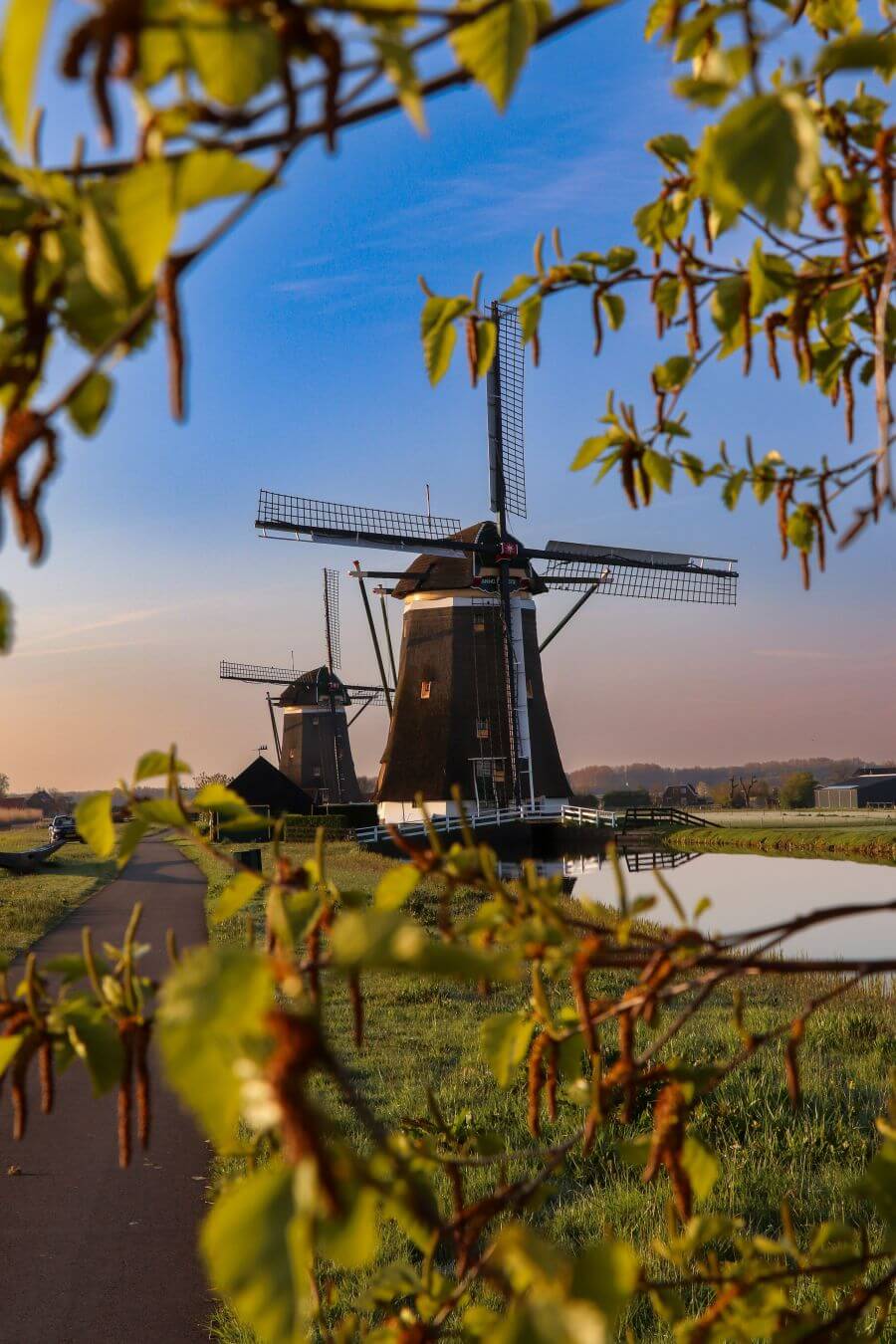
Kinderdijk is almost guaranteed to give you some of the best photos of your trip.
Why the Kinderdijk windmills are different
The mills were not built to look pretty. The Alblasserwaard polder kept sinking while the rivers around it kept rising, so the Dutch built mills to lift water out of the polder, first into large storage basins and then into the river. The eight Nederwaard mills date from 1738 and stand in a staggered line so each one catches the wind. The eight Overwaard mills stand in a straight line because the embankment was too narrow to stagger them, and they are built of wood and thatch to stay light on the soft soil. Once you know this, you will notice the difference yourself when you walk along the canals.
The oldest design on site is the Blokweer mill, a model from around 1500 (the version you see was built in 1630). From 1868 the Wisboom steam pumping station helped the mills during very wet periods, and today electric and diesel pumping stations do the main work. The mills are kept in working order as a backup. The name Kinderdijk means “children’s dike”. According to local legend, after the St. Elizabeth flood of 1421 a cradle with a baby inside washed up here, kept afloat by a cat jumping from side to side. It is a legend, but it is the story every guide tells.
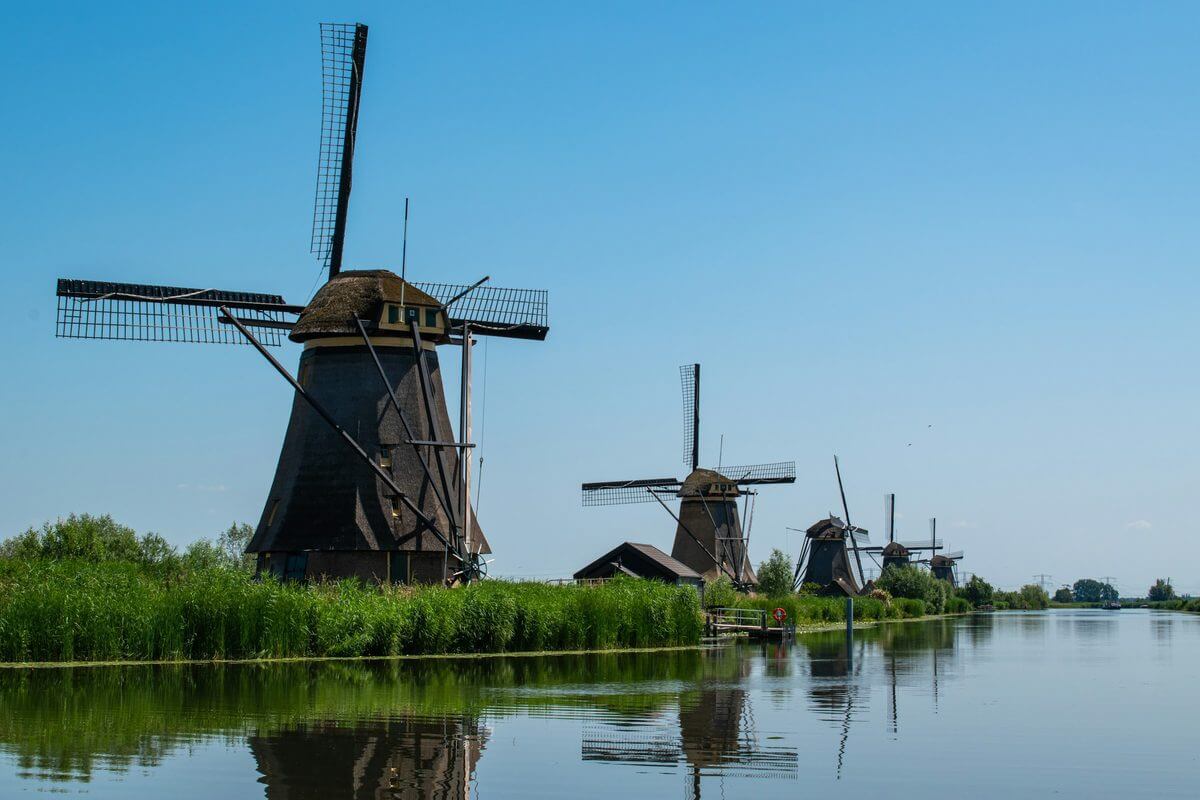
The Overwaard mills: thatched, wooden and in one straight line.
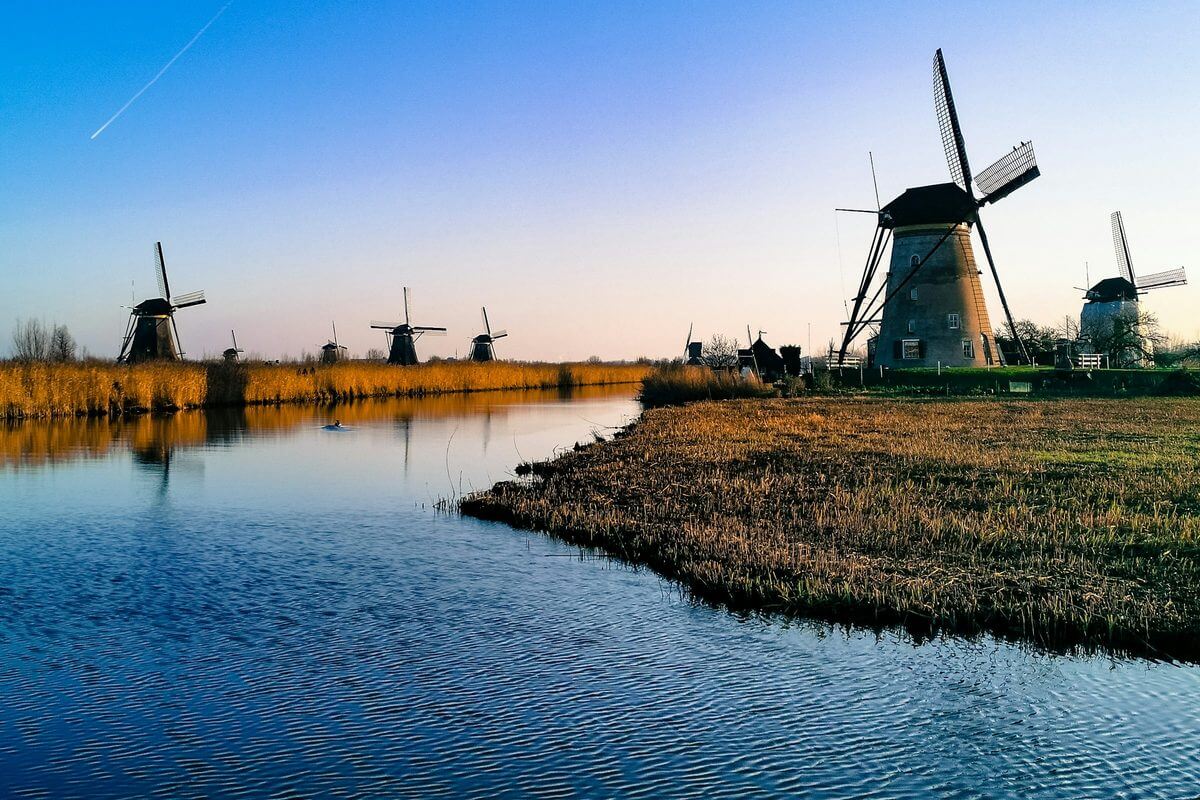
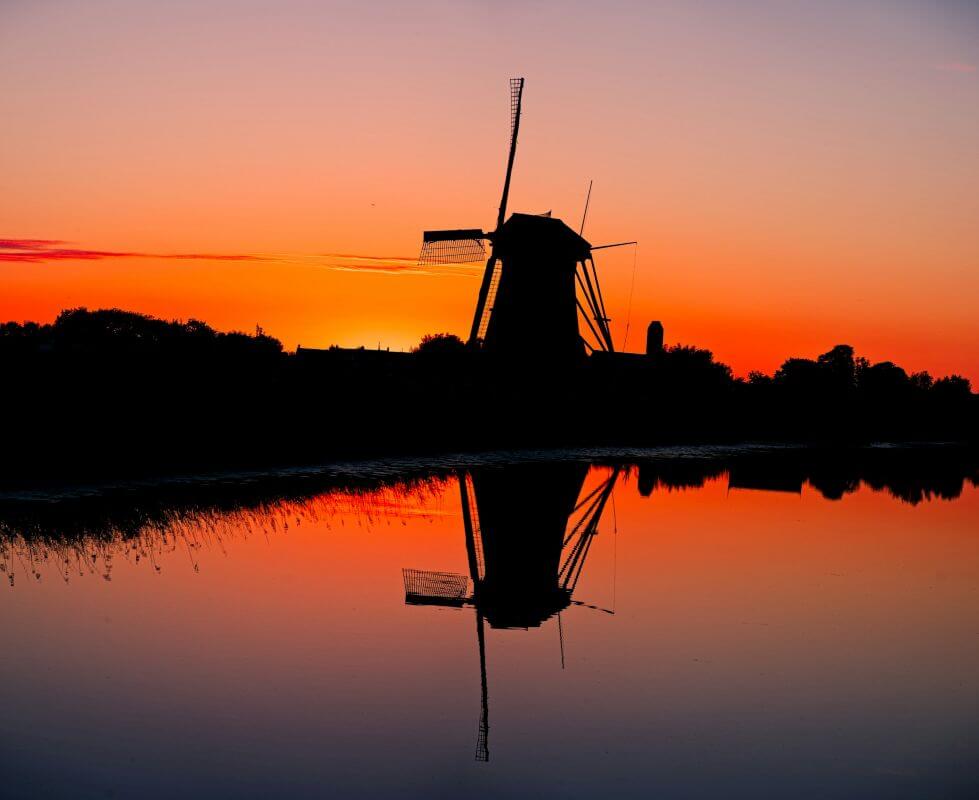
The golden hour makes every photo better, like this one.
Is Kinderdijk worth a visit? Our honest take
It gets busy. More than 900,000 people visit the area every year, and about 370,000 of them buy a ticket. A large share of the ticket holders arrive in groups, many of them from river cruise ships that moor on the Lek. On a summer afternoon you will share the path with a lot of people.
Still, we would not call it a tourist trap. Nothing here was built for visitors: the landscape, the mills and the pumping stations are the real thing, and families live in most of the mills. Ticket income goes to the foundation that maintains the site. What can disappoint is the scale. The area is large, the walk along the mills is long, and on a day without wind the sails may not turn at all. Bring time, comfortable shoes and a jacket. This is open polder, and the wind is the reason the mills are here.
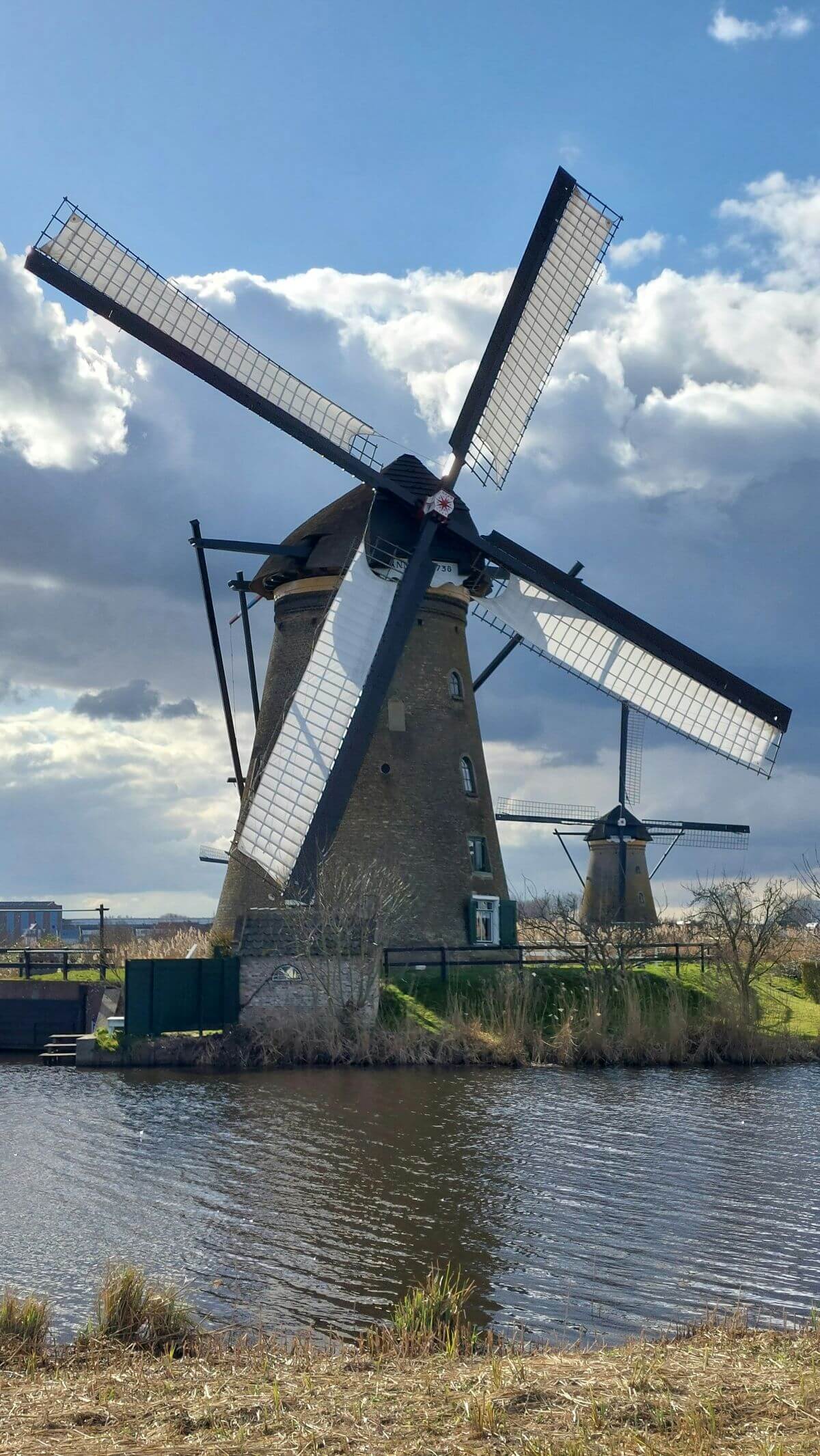
The Nederwaard mills are one of a kind, especially seen together.
Can you visit Kinderdijk for free?
Yes. The footpath and cycle path along the mills is public, open all year and free. You can see every mill from close by without paying. A ticket gets you inside.
| Free (public path) | With a ticket |
|---|---|
| Walk or cycle past all 19 mills, any time of year | Step inside two museum mills, including the Blokweer mill |
| Views of the storage basins and pumping stations from outside | Boat tour along the mills, where you can get on and off |
| Possible before and after opening hours | Wisboom pumping station with a scale model and an interactive windmill game |
| No background information unless you bring it yourself | Introduction film and exhibition in pumping station De Fabriek, plus free audio tours in the online Kinderdijk Guide |
Kinderdijk tickets cost €21 for adults and €9 for children aged 4 to 12. Children up to 3 go free (prices checked in October 2026). Kinderdijk is cashless, so bring a bank card or credit card.
Our booking tip
Take the train to Rotterdam and book the WaterShuttle ticket to Kinderdijk in advance, with free cancellation up to 24 hours before. Arriving by boat is half the fun. Would you rather not plan the route yourself? A private tour from Amsterdam to Kinderdijk, Delft and the Mauritshuis takes care of all transport, or compare all day trips from Amsterdam to Kinderdijk.
Cyclists and walkers can also cross the river with the Driehoeksveer, a small ferry between Kinderdijk, Ridderkerk and Krimpen aan de Lek. Its future after 1 January 2027 is uncertain, so check before you plan a route that depends on it.
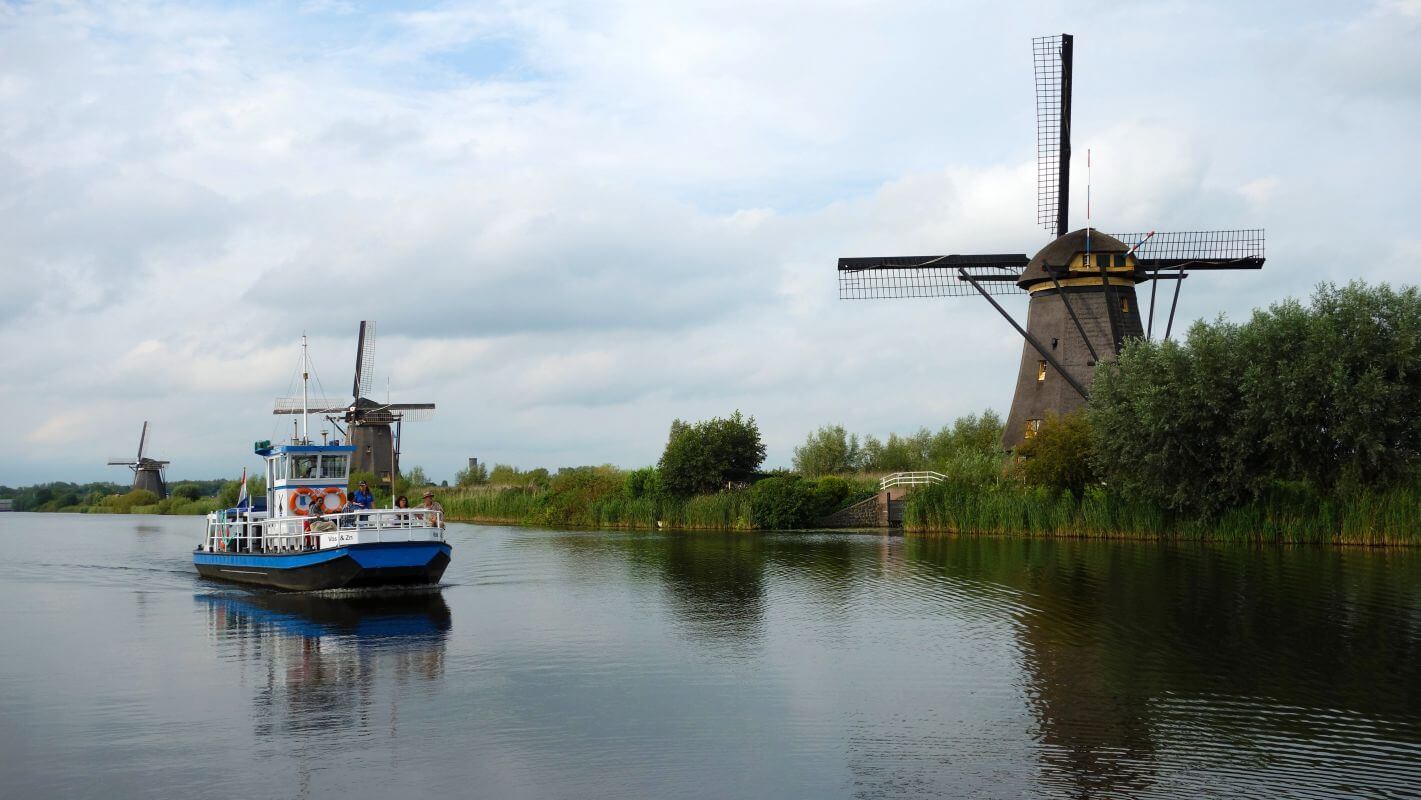
The tour boat takes you along the mills and saves a long walk.
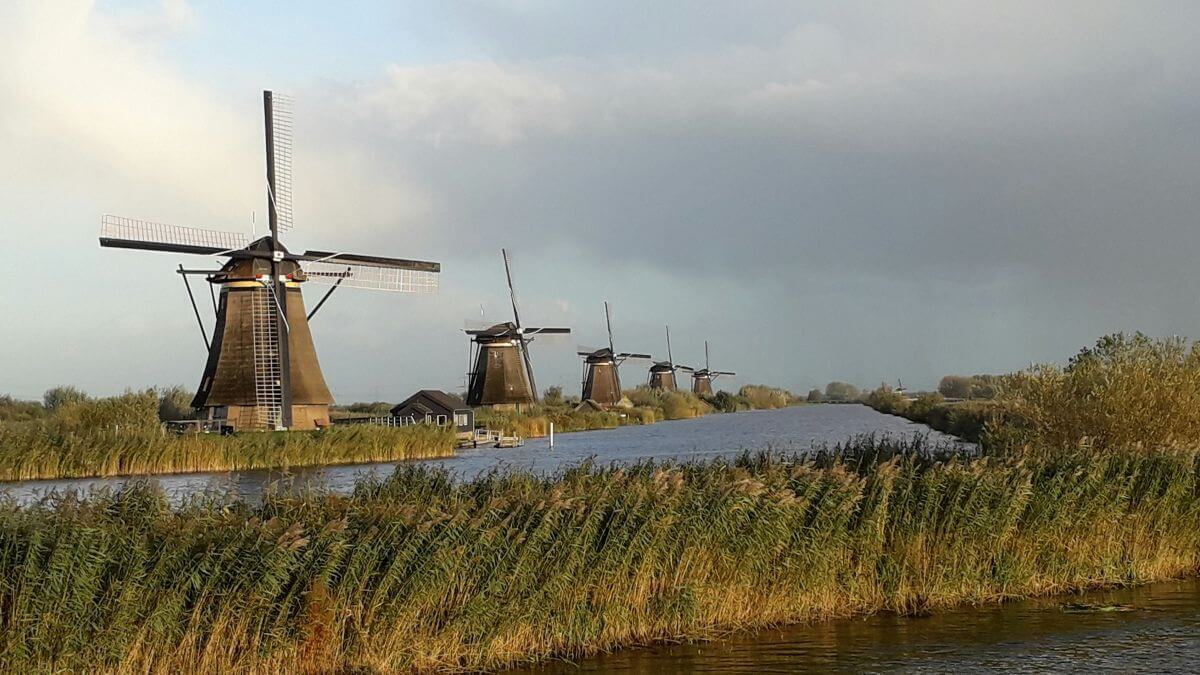
A view you will only find here.
Our verdict
Kinderdijk is one of the few places in the Netherlands where you see the country’s fight against water as a working landscape rather than a museum display. It suits travellers with a full day who like history, photography, cycling or open space. It is less suited to a tight schedule: if you only have a few hours, the Zaanse Schans is much easier to reach from Amsterdam. Our tip is to combine Kinderdijk with Rotterdam, because the fastest routes go through the city anyway.
Kinderdijk or Zaanse Schans?
Both have windmills, but they are very different trips. This comparison helps if you only have time for one.
| Kinderdijk | Zaanse Schans | |
|---|---|---|
| What it is | 19 mills in their original place, part of a working water system | An open-air village of historic mills and houses brought together from the region |
| Mills used for | Draining a polder | Mainly industry: sawing wood, making oil, paint and spices |
| Travel from Amsterdam | About 1.5 to 2 hours each way | About 20 minutes by train |
| Entry | Path free, one ticket for all visitor locations | Village free, pay per mill or museum |
| Feels like | Wide polder landscape, lots of walking or cycling | Compact village with shops, workshops and cafés |
| Best for | A full day, history and landscape lovers | Half a day, first-time visitors with limited time |
If you have already seen the Zaanse Schans, Kinderdijk is a good next step rather than more of the same.
What to do in Kinderdijk: a plan for your day
Most visitors spend three to four hours on site. This order works well:
- Start with the film. The short introduction in pumping station De Fabriek explains the water system, so everything you see afterwards makes sense.
- Take the boat one way. Ride the tour boat out along the mills and walk back, or the other way around. From April to October a second boat, the Cruiser, sails a longer route through the area.
- Visit both museum mills. The Blokweer mill has two resident cats and, on sunny days, rabbits around the yard.
- See the Wisboom pumping station. It shows how steam, and later electricity, helped when wind was not enough.
- Finish with a drink. See the food and drink tips below.
Restaurants and food at Kinderdijk
You will not go hungry. The Kinderdijk-café in the visitor centre has a terrace above the water with a view of the mills, and high chairs for young children. Museum mill Blokweer serves drinks, ice cream and small snacks. The Kiosk on the bank of the Lek sells ice cream, sandwiches and hot dogs while ships pass by. Café De Klok in the village, about 500 metres from the entrance, is another option. Remember that all locations inside the World Heritage site are cashless.
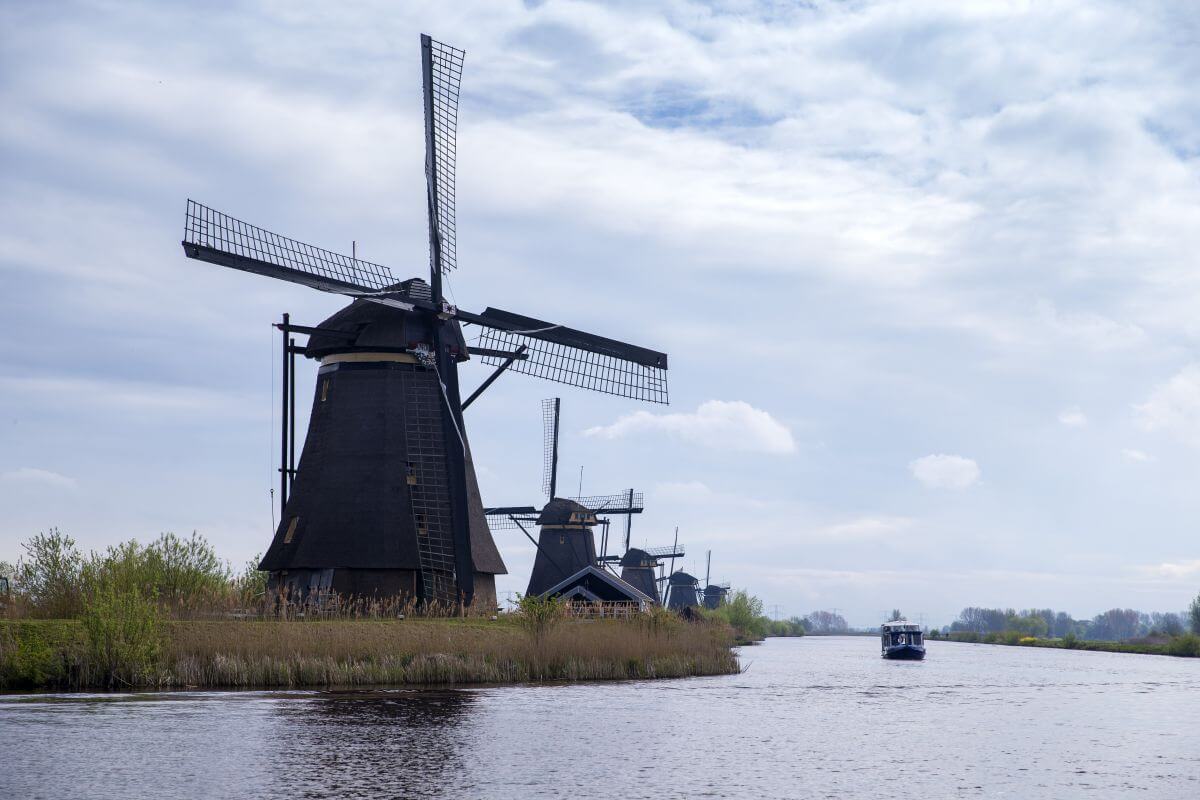
We just could not add enough pictures to this page.
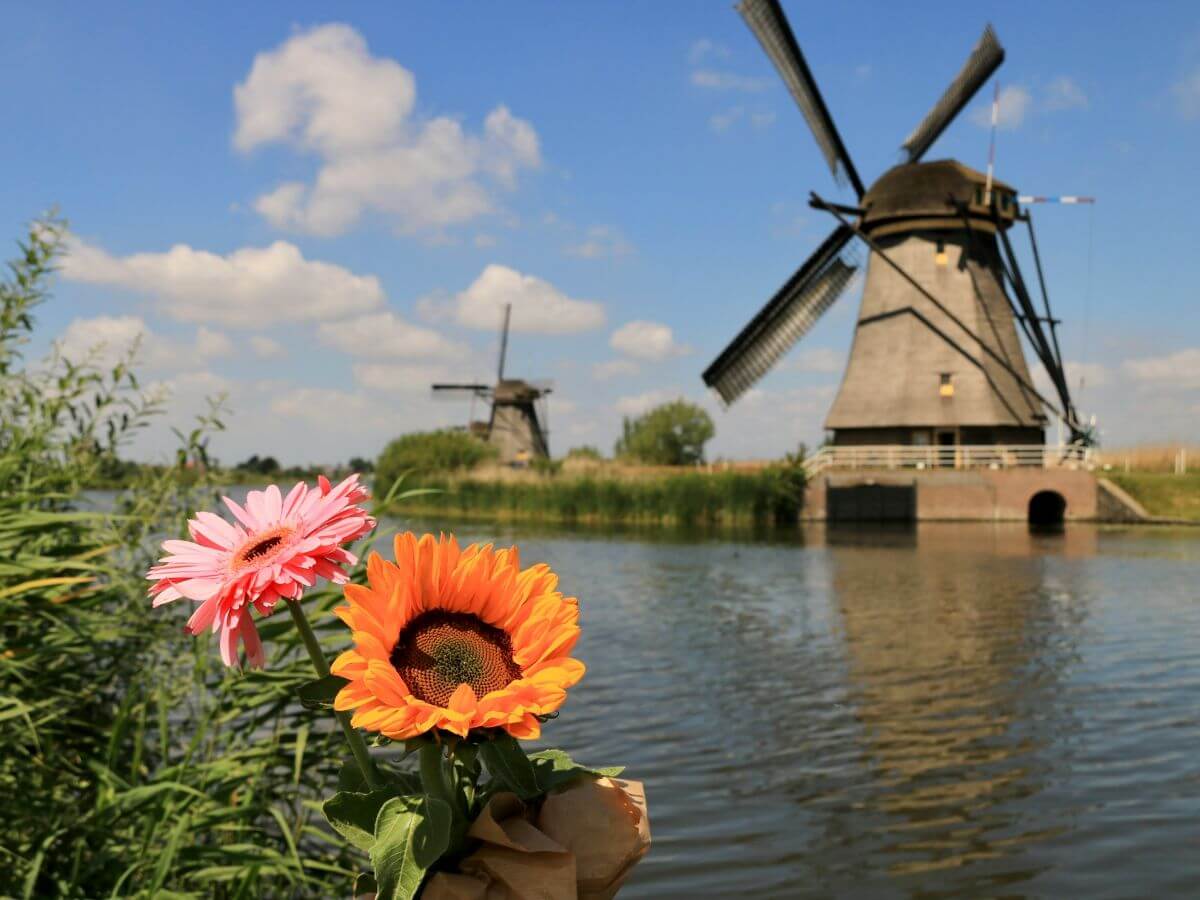
Cycling the dike: the easiest way to see all 19 mills.
How to get to Kinderdijk from Amsterdam and Rotterdam
There is no train station in Kinderdijk. The easiest routes go through Rotterdam, which you reach from Amsterdam Centraal by train in about 40 minutes (Intercity Direct) to just over an hour.
| Route | How it works | Good to know |
|---|---|---|
| Train + WaterShuttle | Train to Rotterdam, then the WaterShuttle boat from the Erasmus Bridge (Willemskade) directly to Kinderdijk in about 30 minutes | The nicest way to arrive. Separate ticket, not part of public transport. A combi ticket with entry is available. Bikes travel free. In 2026 it sails daily until 25 October, then on Friday to Sunday. |
| Train + metro + bus | Train to Rotterdam, metro to Kralingse Zoom, then bus 489 to Kinderdijk | Runs all year and works with a regular public transport card |
| Car | About 1.5 hours from Amsterdam. From 16 March to 1 November you park at the transferium in Alblasserdam and take the included shuttle bus | Parking €9.75 per car, only with an entry ticket. From November to mid-March you park at the entrance. |
| Camper van | Bus and camper parking at Lekdijk 432A, Nieuw-Lekkerland, about 1.7 km from the entrance | €12.50 per day. Staying overnight in this car park is not allowed. |
| Bike | From Rotterdam it is a ride of a little over 15 km. You can also take your bike on the WaterShuttle | Bike rental near the entrance at Tourist Information Kinderdijk (Molenstraat 232) and at Café De Klok |
Kinderdijk opening hours, tickets and address
| Practical | Details |
|---|---|
| Address | Nederwaard 1b, 2961 AS Kinderdijk (parking address in high season: Kabelbaan 1, Alblasserdam) |
| Opening hours 2026 | 6 March to 1 November: 9:00 to 17:30. 2 November to end of December: 10:30 to 16:00. Closed on 25 December. |
| Tickets | Adults €21, children 4 to 12 €9, under 4 free. 10% off online. |
| Payment | Card only, no cash |
| Time needed | Three to four hours on site, plus travel |
| Lockers | In the visitor centre, €6 to €10 per day depending on size |
Kinderdijk Nederwaard 1b
Best time to visit Kinderdijk
Each season gives a different Kinderdijk. The weather matters more than at most attractions, because the sails only turn when there is enough wind. Check the wind forecast the day before.
| When | What to expect |
|---|---|
| Spring and summer | Long opening hours, all boats and the WaterShuttle run daily. Also the busiest time, especially in the afternoon. |
| September | Illumination Week in the first full week of the month, when the mills are lit up in the evening. The Windmill Market in the village usually falls in the same week. |
| Autumn and winter | Shorter opening hours, fewer boat connections and a quieter path. Dress warmly, the polder is exposed. |
| Frozen winters | When the ice is strong enough, skaters come for the windmill skating tours. These are not organised by Kinderdijk, so check ice conditions first. |
| Sunrise and sunset | The public path is open outside opening hours, so photographers can be there for the first and last light. |
What is changing at Kinderdijk in 2027
Kinderdijk is in the middle of a long-term plan, and several changes are planned for 2027. These are plans from the foundation that manages the site and local authorities, so dates can change.
- Museum status. The foundation is applying for official museum status, aiming to be a registered museum in 2027 and to invest more in the exhibitions that year.
- A new entrance zone. Construction of the redesigned entrance area is expected to start in 2027. Expect some building work near the visitor centre.
- Another mill becomes a home again. Overwaard mill 8 is expected to be lived in again from 2027.
- A climate story in a pumping station. The J.U. Smit pumping station is being turned into an experience about climate change and water management.
- A millwright’s workshop. An old shed on site is being set up as a workshop where you can see how the mills are maintained.
- The river ferry. The Driehoeksveer’s operating contract ends on 1 January 2027, and the municipalities are looking for a way to keep it running.
If the usual pattern holds, Illumination Week 2027 will take place from Monday 6 to Saturday 11 September 2027. Check the official agenda once it is announced.
Where to stay near Kinderdijk
Kinderdijk works as a day trip from Amsterdam or Rotterdam, but you can also stay in the area. Around the World Heritage site you will find bed and breakfasts, hotels, holiday parks such as Familie Resort Molenwaard, and campsites. Staying close by lets you walk the path early in the morning, before the day visitors arrive.
Make it a full day out
Kinderdijk combines well with other places in South Holland:
- Rotterdam, for modern architecture and the WaterShuttle back to the city.
- Delft, a historic canal town on the train line between Rotterdam and Amsterdam.
- Fun facts about the Netherlands, including how much of the country lies below sea level.
The WaterShuttle from Rotterdam drops you right at the mills.
How well do you know Kinderdijk?
7 quick questions to test yourself before your visit.
Frequently asked questions about Kinderdijk
Where is Kinderdijk?
Kinderdijk is in the province of South Holland, about 15 km east of Rotterdam, where the rivers Lek and Noord meet. From Amsterdam it takes about 1.5 to 2 hours to get there.
How many windmills are there in Kinderdijk?
There are 19 windmills, most of them built around 1740. Two of them are museum mills that you can visit with a ticket.
Can I visit Kinderdijk for free?
Yes. The path along the mills is public and open all year. You only need a ticket for the museum mills, the boat, the pumping stations and the film.
Can I bring my dog?
Yes, on a leash. Dogs are allowed on the boat and at the visitor locations, but not inside the Kinderdijk-café.
Is Kinderdijk wheelchair accessible?
Mostly. The paths, yards and tour boats are accessible, and the visitor centre lends out two wheelchairs for free on the day. The museum mills themselves have steep stairs and are not accessible.
Can I fly a drone?
No. The area is a protected Natura 2000 nature area and most mills are homes. Flying without a permit can lead to a fine.
Do the windmills always turn?
No. The sails only turn when there is enough wind and the mills are set to run. On Windmill Days as many mills as possible operate, so check the Kinderdijk agenda if seeing turning sails matters to you.
Is Kinderdijk good with kids?
Yes, if they like boats and open space. Children under 4 go free, there are baby-changing facilities in the visitor centre and in De Fabriek, and the Wisboom pumping station has an interactive windmill game.
Your Kinderdijk experience
Have you visited the windmills of Kinderdijk? We'd love to hear how it went and whether you'd recommend it. Let us know and we'll share your review.
Reviews
No reviews found